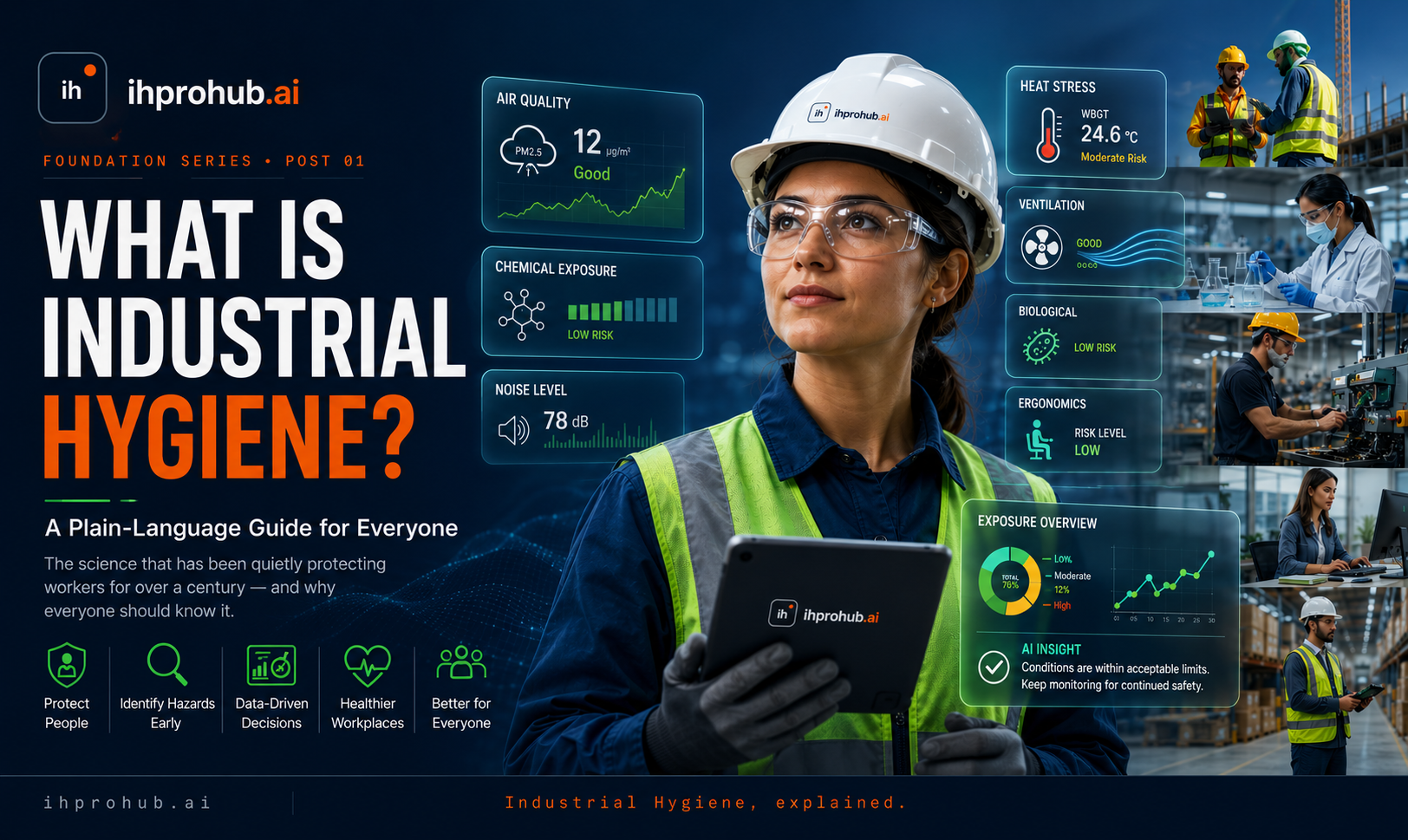
What is Industrial Hygiene?
A Plain-Language Guide for Everyone
The science that has been quietly protecting workers for over a century — and why everyone should know its name.
Every day, millions of people go to work in environments that could hurt them — refineries, hospitals, construction sites, offices, laboratories. Industrial Hygiene is the discipline that stands between those workers and the hazards they may not even be able to see.
If you have never heard of Industrial Hygiene, you are not alone. It is one of the most consequential health disciplines in the world, yet it rarely makes headlines. It does not have the cultural visibility of medicine or engineering. Most people only encounter it — if they encounter it at all — through a safety briefing they half-remember or a poster on a break room wall.
That invisibility is, in a strange way, a measure of its success. When Industrial Hygiene works, nothing happens. No one gets sick. No one goes deaf. No one develops lung disease at fifty because of what they breathed at thirty. The disasters that never occur leave no record.
This post is for everyone — experienced IH professionals who want a resource to share with colleagues, new graduates trying to understand the field they have just entered, and curious professionals from other disciplines who have been wondering what, exactly, Industrial Hygiene is.
The one-sentence definition
Industrial Hygiene is the science and practice of anticipating, recognising, evaluating, and controlling workplace hazards that could cause illness, injury, or impairment to workers and the wider community.
That sentence is precise, but it contains a lot. Let us unpack each part.
This framework — often called AREC — is the intellectual backbone of everything an Industrial Hygienist does, whether they are working in a petrochemical plant in Qatar, a semiconductor fab in Taiwan, a hospital in London, or a construction site in Lagos.
What kinds of hazards does IH deal with?
Industrial Hygienists are concerned with four broad categories of workplace hazard. Understanding these categories helps clarify both the scope of the field and why it requires such a wide-ranging technical foundation.
Chemical hazards
These include airborne substances such as dust, fumes, mists, vapours, and gases. Think of silica dust inhaled by sandblasters, benzene vapours in a refinery, or welding fume in a fabrication shop. Chemical hazards are the traditional heartland of IH — the field’s roots lie in understanding how substances enter the body (through breathing, skin contact, or ingestion) and what harm they cause once inside.
Physical hazards
Noise, heat, cold, vibration, radiation (ionising and non-ionising), and pressure. A worker operating a pneumatic drill is exposed to both noise and hand-arm vibration simultaneously. An outdoor worker in the Arabian Gulf in July faces heat stress that can be lethal without proper controls. A radiographer in a medical facility works around X-ray sources every day. IH addresses all of these.
Biological hazards
Bacteria, viruses, fungi, parasites, and toxins of biological origin. Healthcare workers, laboratory staff, wastewater treatment operators, and agricultural workers all face biological exposures that IH professionals help assess and manage. The COVID-19 pandemic brought this category to global consciousness — but industrial hygienists had been working on airborne pathogen controls for decades before 2020.
Ergonomic hazards
Awkward postures, repetitive motion, forceful exertion, and poorly designed workstations cause musculoskeletal disorders — one of the leading causes of occupational disability worldwide. Ergonomics sits within IH’s scope, though it often overlaps with occupational medicine and human factors engineering.
“Industrial Hygiene is not about making workplaces less productive. It is about making productive workplaces sustainable — places where people can give their best work without giving up their health.”
Why does it matter? The scale of the problem
The numbers behind occupational health are sobering. They are also, because of the very invisibility that characterises the field, often underappreciated.
What is striking about these figures is that the vast majority of those deaths are not from dramatic accidents — falls, explosions, machinery entanglement — but from disease. Cancers caused by carcinogen exposure. Respiratory disease from decades of dust inhalation. Cardiovascular disease accelerated by chronic noise. Conditions that develop slowly, silently, and often irreversibly.
This is precisely where Industrial Hygiene is most essential, and most distinctive. Medicine treats disease after it occurs. IH prevents it from occurring in the first place.
How is IH different from Health & Safety?
This is the question Industrial Hygienists are asked most often, usually by well-meaning colleagues who assume the two terms are interchangeable. They are not — though they are closely related.
Health and Safety (or HSE — Health, Safety, and Environment) is a broad umbrella that covers accident prevention, emergency response, legal compliance, incident investigation, and process safety, among much else. It is primarily concerned with acute risk — the risk of something going badly wrong in the near term.
Industrial Hygiene is a specialist discipline within that broader landscape, focused specifically on chronic health risk — the slow-burning, exposure-driven risks that accumulate over working lifetimes. An IH professional brings deep knowledge of toxicology, exposure science, sampling methodology, analytical chemistry, and epidemiology. That expertise is qualitatively different from general HSE practice.
If HSE is the general practitioner, Industrial Hygiene is the specialist physician. Both are essential. Neither fully replaces the other. The best occupational health programmes have both — working together.
What does an Industrial Hygienist actually do on a typical day?
The daily reality of IH work is more varied than most people expect. It is equal parts science, communication, detective work, and persuasion.
On any given day, an IH professional might begin with a walk-through of an active plant to identify new or changing hazards — a process called a baseline survey. They might then set up air sampling equipment on a worker to measure their personal exposure to a particular chemical over an eight-hour shift. In the afternoon, they could be reviewing the results of a noise dosimetry study and preparing a report for management that recommends engineering controls — acoustic enclosures, vibration-damping mounts — rather than simply issuing ear defenders and calling the job done.
Towards the end of the day, they might sit in a meeting with a project engineering team reviewing the design of a new processing unit before it is built — flagging chemicals that will require local exhaust ventilation, or layout choices that will trap heat and create stress for operators. This is the anticipation phase: influencing decisions before they become problems.
Throughout all of this, they are translating technical findings into language that site managers, workers, medical officers, and regulators can all understand. Communication is as central to the job as chemistry.
Where do Industrial Hygienists work?
Almost everywhere that people work in potentially hazardous conditions. The Oil & Gas and LNG industries are among the largest employers of IH professionals globally — high-hazard environments with complex chemical inventories, extreme physical conditions, and large, diverse workforces require dedicated expertise. Mining, construction, manufacturing, healthcare, agriculture, military, and government regulatory bodies all employ IH professionals.
In the Gulf region — Qatar, UAE, Saudi Arabia, Kuwait — the combination of major hydrocarbon and petrochemical operations, extreme heat, and large migrant workforces has created a significant and growing demand for qualified IH professionals. Regional standards are evolving rapidly, and the gap between the scale of exposure risk and the availability of qualified IH practitioners remains wide.
How does someone become an Industrial Hygienist?
The educational pathways into IH are broader than many realise. Many practitioners come from backgrounds in chemistry, chemical engineering, environmental science, biology, or occupational health nursing. What they share is an interest in applying scientific knowledge to the practical problem of protecting human health at work.
Professional certification — the Certified Industrial Hygienist (CIH) credential in North America, the Registered Occupational Hygienist (ROH) in the UK and international contexts, and emerging regional frameworks — signals a practitioner’s commitment to professional standards and continuing competence. But the field also has room for IH technicians, generalist HSE professionals with IH competencies, and data specialists who are increasingly contributing to the discipline’s analytical capabilities.
“Industrial Hygiene” is the term used predominantly in North America and the Gulf region. In the UK, Australia, and much of the international community, the same discipline is called “Occupational Hygiene.” The practice is identical — only the name differs.
Where is the field going?
Industrial Hygiene is in a period of genuine transformation. The tools are changing — wearable real-time sensors are beginning to replace periodic grab sampling; machine learning models are being applied to exposure prediction; digital platforms are replacing paper-based monitoring records. The hazard landscape is also shifting, with engineered nanomaterials, novel solvents, and PFAS compounds presenting new evaluation challenges.
At the same time, the fundamental mission has not changed. It remains, as it has been for over a century, to ensure that people do not pay for their livelihoods with their health.
That mission is what this platform — IHProHub — is built around. Our goal is to give Industrial Hygiene professionals the tools, knowledge, and community they need to do their work better, and to help the wider world understand why this discipline matters.
“The best workplace health programme is the one where workers go home at the end of their careers in the same health they started with. That is the standard Industrial Hygiene holds itself to.”
Key takeaways
Industrial Hygiene is the science of identifying and controlling workplace health hazards — chemical, physical, biological, and ergonomic. It operates through a four-stage framework: anticipate, recognise, evaluate, and control. It is distinct from general Health & Safety in its specialist focus on chronic, exposure-driven health risk rather than acute accident risk. It is practised globally across virtually every high-hazard industry, and it is evolving rapidly as digital tools and new hazard types reshape the field. And its core purpose — protecting the health of working people — is as relevant today as it was when the field first emerged from the coal mines and factories of the industrial revolution.
Welcome to IHProHub. There is much more to explore.
Ready to go deeper?
IHProHub is building the tools, content, and community that Industrial Hygiene professionals in Oil & Gas and LNG need. Join early and shape what comes next.
Explore IHProHub Tools Browse the Blog