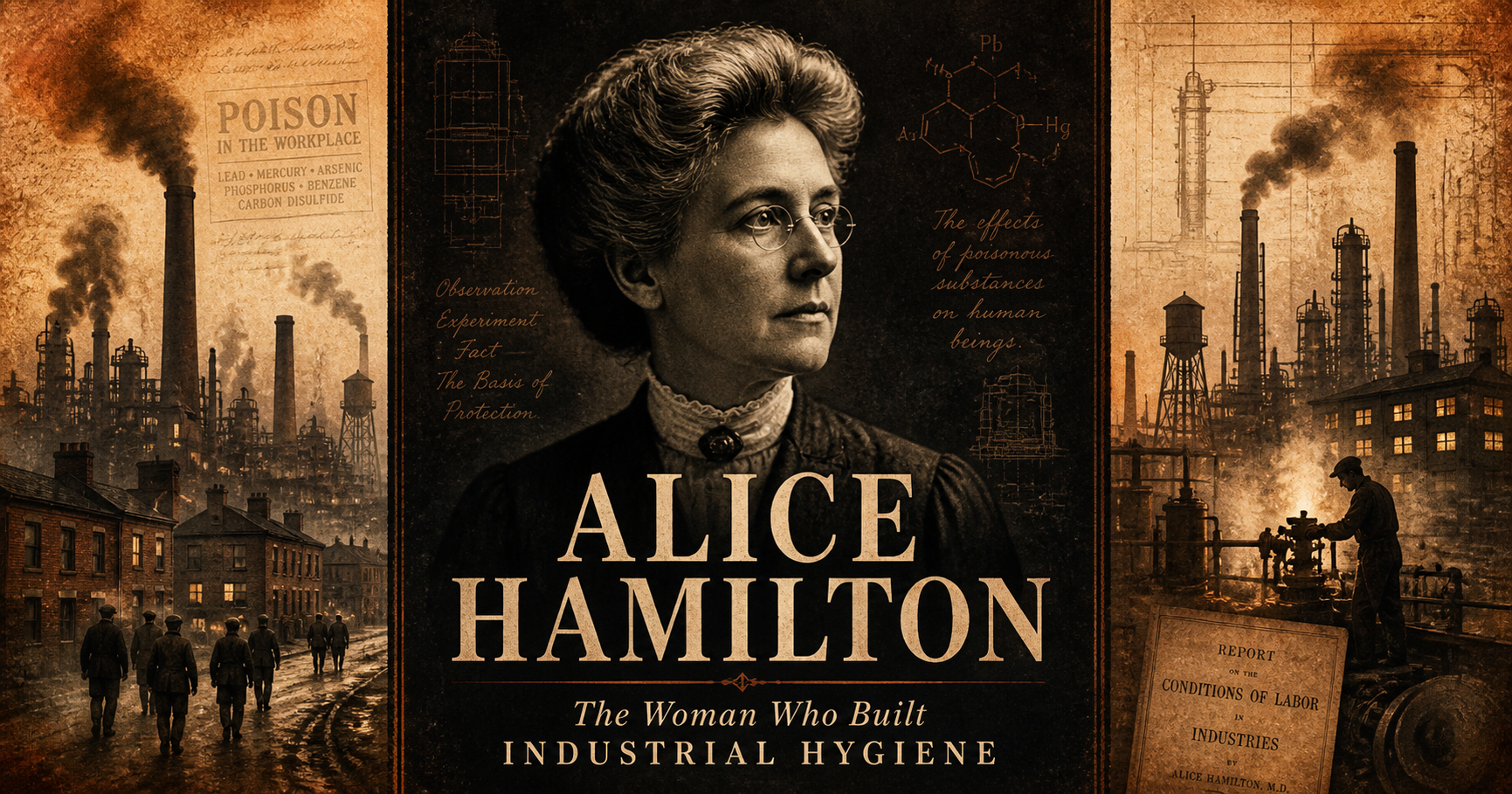
Alice Hamilton:
The Woman Who Built
Industrial Hygiene
The untold story of the first female Harvard professor and the physician whose tenacity turned workplace suffering into science.
In 1910, a physician walked into the lead smelters, munitions factories, and paint shops of industrial America and asked a question no one had thought to ask before: what, exactly, is making these workers sick? Her name was Alice Hamilton. The field she built from that question has protected hundreds of millions of lives.
Alice Hamilton was born in 1869 in New York City into a prosperous Indiana family that placed an unusually high value on women’s intellectual life. Her grandmother had attended one of America’s first female seminaries. Her mother read voraciously. Her father, a wholesale grocer, encouraged his daughters to think seriously about the world. This environment — bookish, morally earnest, confident in female capability — shaped Hamilton profoundly.
She chose medicine not from a burning childhood vocation but from a pragmatic calculation. Medicine, she reasoned, offered a woman both independence and usefulness — two things she valued above comfort. She earned her medical degree from the University of Michigan in 1893, then pursued postgraduate training in bacteriology and pathology in Germany and at Johns Hopkins, at a time when women in laboratories were tolerated rather than welcomed.
By the late 1890s, she was practising bacteriology and teaching at the Woman’s Medical School of Northwestern University in Chicago. She was competent, serious, and largely unremarkable in her trajectory — one of a small cohort of pioneering female physicians finding their footing in a profession that barely acknowledged their existence. Nothing yet suggested she would become one of the most consequential public health figures of the twentieth century.
That changed when she moved into Hull House.
Hull House, founded by Jane Addams in 1889, was a settlement house on the Near West Side of Chicago — a neighbourhood dense with recent immigrants from Poland, Italy, Russia, Greece, and a dozen other countries, almost all of them employed in the factories, foundries, and packing houses that made Chicago the industrial engine of the American Midwest. The settlement house model put educated, middle-class reformers into direct contact with the urban poor. Residents lived in the community. They shared its streets, its schools, its problems.
For Hamilton, who moved in as a resident in 1897 and would remain connected to the house for decades, this proximity was transformative. She began meeting the workers — men who returned from shifts at the smelters visibly ill, women from the garment factories with chronic respiratory complaints, children whose fathers had died young of conditions that had no official name because no one had bothered to study them.
She was always more disturbed by what she did not know than by what she did — and what she did not know, in those early Hull House years, was why so many workers were dying.
The medicine of the era had names for the diseases — lead poisoning, phosphorus necrosis, mercury tremor — but almost no systematic understanding of how and where workers were acquiring them. There was no occupational health infrastructure, no routine workplace monitoring, and crucially, no legal framework that held employers responsible for the health consequences of their processes. Workers who fell ill simply fell ill. If they recovered, they returned to the same conditions. If they did not, they were replaced.
Hamilton read everything available on occupational disease — which was thin, mostly European, largely descriptive rather than investigative. She began to understand that the gap was not primarily medical but methodological. No one was going into the workplaces, interviewing the workers, tracing the exposure pathways, and connecting cause to effect with the rigour that the problem demanded. She decided to do it herself.
In 1910, the newly appointed Illinois Commission on Occupational Diseases hired Hamilton to conduct the first systematic survey of industrial poisons in the state. It was, by any measure, an extraordinary assignment for any physician of the era — let alone a woman. She was thirty-nine years old.
What she produced over the next several years was methodologically unprecedented. She did not sit in a laboratory. She went into the field. She walked the floors of lead smelters in East Chicago, white lead factories in Cincinnati, munitions plants during the First World War, and the radium-dial painting operations where young women painted watch faces with luminescent paint and were instructed to point their brushes with their lips. She interviewed workers. She cross-referenced death certificates. She followed workers home to understand the full exposure picture — the dust on their clothes, the lead-contaminated surfaces in their kitchens, the children who played in their workrooms.
Hamilton’s first major investigation documented 578 cases of lead poisoning across Illinois industries. She identified nineteen distinct trades in which lead exposure was creating chronic illness — many of which employers had assumed were safe. The report directly influenced the first Illinois occupational disease laws, enacted in 1911.
Crucially, she went beyond identifying that poisoning existed to tracing precisely how absorption occurred — through inhalation of fine dust, through hand-to-mouth contact, through contaminated food and water in workplace canteens. This exposure-pathway thinking was the embryo of what would become modern industrial hygiene methodology.
Her approach combined clinical medicine with epidemiology, workplace observation with worker testimony, and scientific rigour with moral urgency. She understood that numbers alone would not move employers or legislators — she needed stories, human faces on the data, without sacrificing the evidentiary standards that gave her findings authority.
She was also, by every account, exceptionally skilled at gaining access. In an era when female reformers were routinely dismissed as sentimental and unscientific, Hamilton disarmed factory owners and plant managers with a combination of professional precision and personal warmth. She rarely arrived as an adversary. She arrived as a physician who wanted to understand their processes — and who happened to have opinions about what was killing their workers.
The investigations expanded over two decades. She studied carbon monoxide poisoning in the steel industry, mercury poisoning in the felt-hat trade, silica dust among tunnellers, phosphorus necrosis in match factory workers, and the neurological effects of tetraethyl lead in the emerging automobile fuel industry. Each investigation followed the same disciplined pattern: define the population, trace the exposure, document the disease, recommend the control.
Hamilton once wrote that her method was simply “shoe-leather epidemiology” — going where the sick workers were and asking why. In that simplicity lay a revolution.
— Reflecting on her investigative approach, circa 1925In 1919, Harvard Medical School appointed Alice Hamilton as its first female faculty member — an assistant professor of industrial medicine. She was fifty years old. She would remain the only woman on the Harvard faculty for sixteen years.
The appointment was a remarkable recognition of her stature, but it came with conditions that speak volumes about the institutional climate of the time. Hamilton was not permitted to march in commencement processions — those were for men only. She was not entitled to use the Faculty Club. She received no pension. Her appointment was periodically renewed rather than tenured, a perpetual provisionality that was never applied to her male colleagues.
She accepted these conditions without public complaint, though she was privately clear-eyed about their nature. She understood that the work mattered more than the ceremony, and that her presence at Harvard — however circumscribed — expanded what was possible for the women who would follow her.
Hamilton later wrote that the Harvard dean informed her she could attend the dinners held for visiting alumni, but “on the condition that she not join the alumni procession into the football stadium.” She noted that she had no particular interest in football, and accepted the condition cheerfully. The anecdote reveals both the pettiness of institutional sexism and Hamilton’s characteristic refusal to be diminished by it.
At Harvard she continued her investigations, taught the first formal courses in industrial medicine in the United States, and — perhaps most consequentially — began to systematise the field. Her textbook, Industrial Poisons in the United States, published in 1925, was the first comprehensive American work on occupational toxicology. It brought together two decades of field investigation into a reference that practitioners, employers, and regulators could actually use.
She retired from Harvard in 1935, at the mandatory retirement age of sixty-five. She was not done. She continued to publish, to consult, and to advocate. She lived to be one hundred years old, dying in 1970 — long enough to see OSHA’s creation debated in the United States Congress, though she did not quite live to see it signed into law in December of that year.
It is easy to celebrate Alice Hamilton as a pioneer and leave it there — the first woman this, the first study that. But the more important question is methodological: what, precisely, did she contribute to how Industrial Hygiene is practised today?
The answer is substantial. Hamilton established, through practice rather than proclamation, several principles that remain foundational to the field.
First, she demonstrated that occupational disease investigation requires going to the source — the workplace — rather than waiting for the sick to present in clinic. The exposure environment is the site of understanding. This seems obvious now. In 1910, it was a genuine innovation.
Second, she established that worker testimony is valid scientific data. She interviewed thousands of workers throughout her career and treated their accounts of symptoms, timelines, and conditions as primary evidence — not merely as anecdote to be filtered through physician interpretation. This respect for the worker’s own knowledge of their exposure was methodologically ahead of its time.
Third, she linked exposure to outcome through careful documentation and comparative analysis. She was doing what we would now call epidemiological investigation — comparing populations with and without exposure, tracing dose-response relationships, identifying confounders — without the formal statistical machinery that would later be developed to support such work.
Fourth, and perhaps most practically, she showed that identification of a hazard was only the first step. The end point was always control. Her reports consistently included specific recommendations: ventilation changes, process modifications, substitution of less toxic materials, personal protective equipment where engineering solutions were insufficient. She was, in modern terms, working through the hierarchy of controls before that hierarchy had a name.
There is a version of Alice Hamilton’s story that frames her as an exceptional individual whose greatness overcame the obstacles placed before her by a sexist era. That version is not wrong, but it is incomplete. Hamilton was exceptional — but she also operated within a community of reformers, scientists, and activists who supported, challenged, and amplified her work. Hull House alone produced Jane Addams, Florence Kelley, and a generation of progressive social scientists. Hamilton was a product of that milieu as much as she was an outlier within it.
What is undeniable is what the field she built has produced. Modern occupational exposure limits — the numbers that define acceptable concentrations of airborne chemicals in workplaces worldwide — trace their intellectual lineage directly to Hamilton’s method of linking measured or estimated exposure to documented health outcomes. The Threshold Limit Values published by the American Conference of Governmental Industrial Hygienists (ACGIH), and the Occupational Exposure Limits used by regulators from OSHA to the EU to the Gulf’s national frameworks, are the institutionalised descendants of the investigative logic Hamilton developed in the smelters and factories of industrial Chicago.
Beyond the technical legacy, Hamilton left something harder to quantify but equally important: a moral framework for the work. She believed, and demonstrated through practice, that science in service of workers’ health was not a lesser application of scientific skill but among its highest. She held to that conviction through decades of institutional resistance, industry pushback, and the quiet erosion of indifference.
That conviction — that the people who build the world deserve a science that protects them while they do it — is the conviction on which every IH professional operates today, whether they know Hamilton’s name or not.
They should know her name.
Standing on her shoulders
Alice Hamilton spent her career doing something that felt radical at the time and obvious in retrospect: taking workers’ health seriously enough to study it rigorously. That is what Industrial Hygiene still does — with better tools, broader reach, and a global professional community she could not have imagined.
IHProHub is built on the same conviction she carried into every factory she walked into. Explore our tools, read the blog, and join a community that takes the work as seriously as she did.