OSHA PELs, NIOSH RELs, and ACGIH TLVs:Which exposure limits should you actually use?
OSHA PELs, NIOSH RELs, and ACGIH TLVs:
Which exposure limits should you actually use?
Three US agencies publish three different numbers for the same chemical. Understanding why — and which one protects workers most — is one of the most practically important questions in Industrial Hygiene.
If you have ever pulled up an occupational exposure limit for a chemical and found three different numbers staring back at you — one from OSHA, one from NIOSH, one from ACGIH — you have encountered the most confusing feature of Industrial Hygiene practice in the United States. This post explains exactly what each number means, why they differ so dramatically, and which one an IH professional should actually be working to.
What occupational exposure limits actually are
An occupational exposure limit (OEL) is a concentration of an airborne substance — expressed in parts per million (ppm) or milligrams per cubic metre (mg/m³) — below which nearly all workers can be repeatedly exposed over a working lifetime without experiencing adverse health effects. That definition sounds simple. The complications begin when you ask: who decided on that concentration, using what data, and with what legal authority?
In the United States, three organisations publish widely referenced OEL values, each with a fundamentally different legal status, update frequency, and methodological basis. Understanding those differences is not academic trivia — it has direct implications for whether your IH programme is legally compliant, whether it is scientifically current, and whether it is actually protecting your workers.
— OSHA, 29 CFR 1910.1000
— NIOSH Pocket Guide to Chemical Hazards
— ACGIH (American Conference of Governmental Industrial Hygienists)
The OSHA PEL: legally binding, scientifically dated
When OSHA was created by the Occupational Safety and Health Act of 1970, Congress gave the new agency the authority to adopt existing national consensus standards as its own — without the lengthy rulemaking process that would normally be required. OSHA took that shortcut. It adopted the 1968 American National Standards Institute (ANSI) standards and, critically, the 1968 ACGIH Threshold Limit Values — wholesale — as its Permissible Exposure Limits. Those values were codified in 29 CFR 1910.1000, Table Z-1, Z-2, and Z-3.
The problem is that most of those values have not been meaningfully updated since 1971. Science has moved. Our understanding of toxicology, carcinogenicity, and chronic low-level exposure has advanced dramatically over five decades. OSHA PELs largely have not kept pace. OSHA attempted a comprehensive overhaul in 1989, updating or establishing PELs for nearly 400 substances — but the effort was vacated by the Eleventh Circuit Court of Appeals in 1992, reverting most limits back to their 1971 values.
The result is a regulatory floor that is, for many substances, outdated by modern health science. OSHA PELs are the legal minimum — complying with them means you are not breaking the law. It does not necessarily mean your workers are adequately protected.
There are important exceptions to the dated-PEL picture. OSHA has issued substance-specific standards for a number of high-priority chemicals — silica (2016), beryllium (2017), asbestos (1994 revision), benzene (1987), and others — that supersede the Table Z values for those substances. If a substance-specific standard exists, it takes precedence over Table Z. Always check for substance-specific standards before relying on Table Z alone.
The NIOSH REL: current science, no legal teeth
The National Institute for Occupational Safety and Health publishes Recommended Exposure Limits based on ongoing review of health and safety data. NIOSH RELs are scientifically current in a way that OSHA PELs, frozen largely in 1971, are not. NIOSH can and does publish RELs that are significantly lower than the corresponding OSHA PEL — reflecting tighter understanding of health effects — without waiting for the slow machinery of federal rulemaking.
The critical qualifier: NIOSH RELs carry no regulatory force. They are recommendations, not requirements. OSHA is not obligated to adopt them. Employers are not legally required to meet them. But they are published by a federal agency and are freely available in the NIOSH Pocket Guide to Chemical Hazards at cdc.gov — which means they carry real professional weight even without legal enforceability.
For IH professionals, NIOSH RELs serve as a scientifically current benchmark against which to evaluate exposures. When the NIOSH REL for a substance is substantially lower than the OSHA PEL, that gap is a signal: the older limit may not adequately protect workers from long-term health effects, and a more protective standard should be applied in your programme even if the law does not require it.
The ACGIH TLV: gold standard, with access constraints
The American Conference of Governmental Industrial Hygienists publishes Threshold Limit Values that are revised annually based on the current body of scientific literature. The TLV committee reviews new toxicological and epidemiological evidence continuously, and the annual TLVs & BEIs publication reflects that ongoing scientific synthesis. This makes ACGIH TLVs the most scientifically current of the three systems — and, in the professional IH community, the most widely referenced for programme design and exposure assessment.
TLVs are not law. They have no regulatory authority. But they carry the weight of the professional consensus of Industrial Hygienists who review and debate each value. Many IH professionals — and many corporate IH programmes — treat TLVs as the working benchmark for exposure assessment, while maintaining OSHA PEL compliance as the legal baseline.
There is an important practical constraint: ACGIH TLVs are copyrighted. The numerical values are not freely available. Access requires purchasing the annual publication or subscribing to a service that licenses the data. This has implications for how IH platforms and tools can reference TLVs — including IHProHub, which uses public-domain OSHA PELs and NIOSH RELs in its AI tools, and directs users to the ACGIH publication for current TLV values.
TLVs were where OSHA PELs started in 1971. In the decades since, ACGIH has continued updating while OSHA’s Table Z largely has not. The gap between them is a direct measure of how far occupational health science has moved without regulatory enforcement keeping pace.
Head-to-head: what each system offers
| Attribute | OSHA PEL | NIOSH REL | ACGIH TLV |
|---|---|---|---|
| Legal status | Mandatory LAW | Advisory REC | Voluntary VOL |
| Issuing body | US Department of Labor (OSHA) | US DHHS / CDC (NIOSH) | ACGIH (professional organisation) |
| Scientific currency | Mostly 1968–1971 data with substance-specific exceptions |
Current, regularly updated | Current, annually revised |
| Cost to access | Free — public domain 29 CFR 1910.1000 |
Free — cdc.gov/niosh/npg | Paid publication Copyright protected |
| Number of substances | ~500 (Table Z-1/Z-2/Z-3) | ~700 | 700+ |
| Relative stringency | Often the least protective for outdated substances |
Typically more protective than PEL where they differ |
Often the most health-protective of the three |
| Carcinogen approach | Substance-specific standards for select carcinogens only |
Lowest feasible / zero threshold approach |
Lowest feasible for A1/A2 classified carcinogens |
| Biological exposure indices |
Some, in substance-specific standards only |
Limited BEI equivalents | Comprehensive BEIs published alongside TLVs |
| GCC/MENA legal weight | Referenced in some GCC contractor standards |
Referenced as guidance in IH programmes |
Widely referenced by IH practitioners regionally |
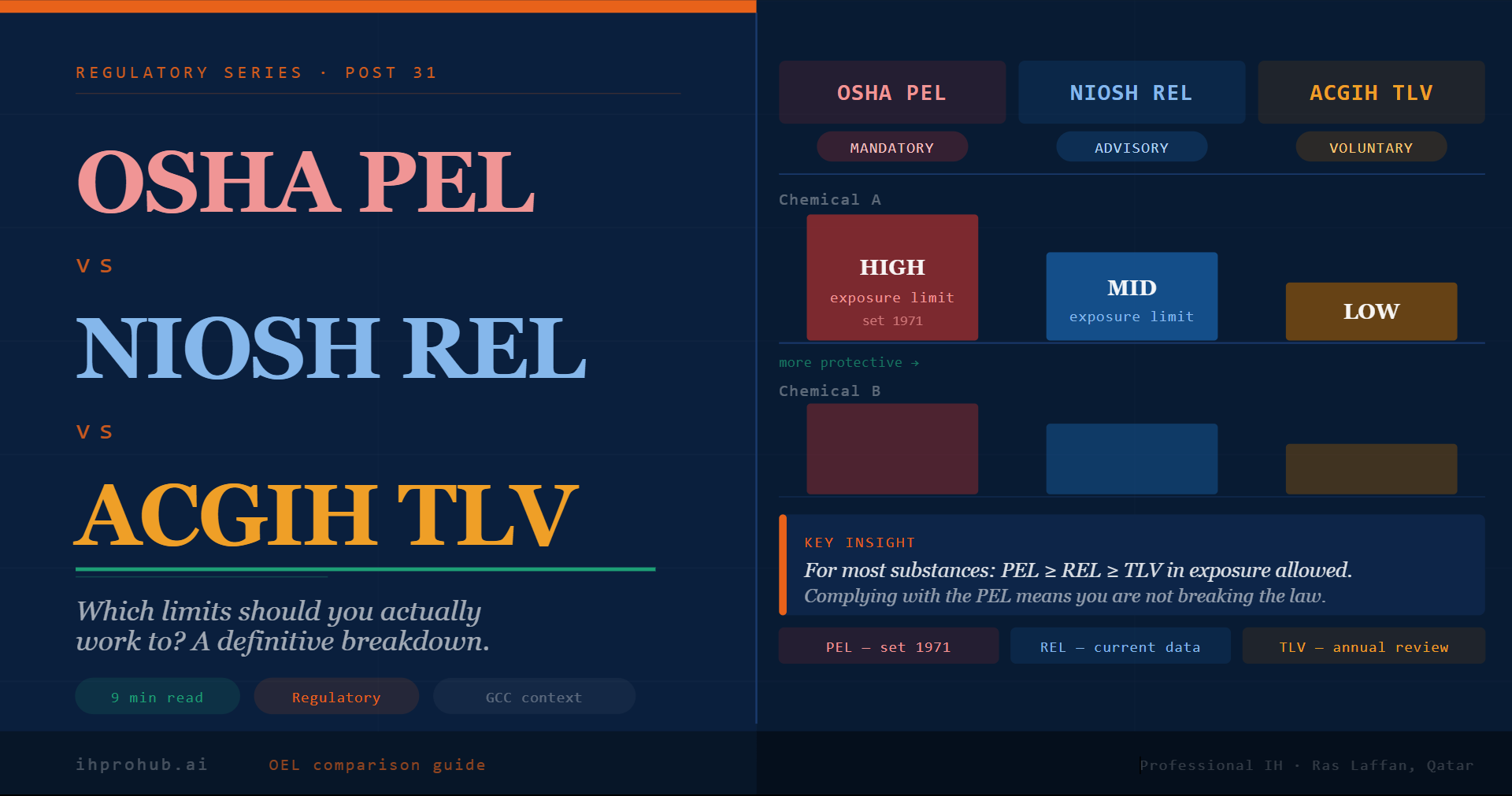
The pattern that emerges from this comparison is consistent: for most substances, OSHA PEL ≥ NIOSH REL ≥ ACGIH TLV in terms of the concentration allowed. In other words, OSHA often permits the highest exposure, NIOSH recommends a lower one, and ACGIH recommends the lowest. Meeting the OSHA PEL alone may leave workers exposed at concentrations that current science considers harmful.
This is not a hypothetical concern. NIOSH has conducted systematic analyses comparing PELs to current scientific evidence and found that for a significant proportion of regulated substances, the OSHA PEL does not adequately protect workers from the risk of occupational illness. The 2011 NIOSH publication “Preventing Occupational Respiratory Disease from Exposures Caused by Dampness in Office Buildings, Schools, and Other Nonindustrial Buildings” is one example of NIOSH publishing health-based guidance well ahead of any OSHA rulemaking on the topic.
The GCC and MENA context: which limits apply?
For operations under QatarEnergy’s HSE Management System — including Technip Energies and other major EPC contractors operating in Ras Laffan — the expectation is generally that IH programmes meet or exceed OSHA PELs, with NIOSH RELs and ACGIH TLVs used to inform the programme where they are more protective. The QE HSE-MS does not specify a single OEL authority, giving IH professionals scope to apply the most health-protective available standard.
A particular issue in GCC operations is heat stress. Qatar’s Ministerial Decision No. 16 of 2006 establishes specific provisions for outdoor work during summer months — this is a GCC-specific regulatory layer that sits on top of, and in some respects replaces, the general OEL framework for heat as a physical hazard. No US-equivalent rule applies here; the regional regulatory framework is what governs, and IH professionals operating in Qatar must know it specifically.
The practical guidance for GCC-based IH practitioners: use OSHA PELs as your documented compliance baseline, apply NIOSH RELs and ACGIH TLVs as your professional standard for programme design, and layer on local regulatory requirements — particularly Qatar MoPH, QCD, and sector-specific frameworks — where they apply.
The verdict: which limits should you actually work to?
The honest answer is: all three, in a deliberate hierarchy. Here is the decision framework that most experienced IH professionals apply, and that reflects the professional consensus of AIHA guidance on exposure assessment strategy.
One final point that experienced practitioners know but new IH professionals sometimes miss: OELs are 8-hour time-weighted averages for healthy adult workers under normal conditions. They do not automatically account for extended work shifts, individual susceptibility, the combined effect of simultaneous exposures, or physical exertion that alters breathing rates. Your IH programme should address all of these factors — OELs are a starting point for assessment, not its conclusion.
Look up OSHA PELs, NIOSH RELs, and GCC regulatory context in seconds — not hours
IHProHub’s Exposure Assessor and Regulatory Q&A tools are built on public-domain OSHA and NIOSH data, with specialist GCC/MENA regulatory depth for Qatar, UAE, and KSA operations. Ask about any chemical, any jurisdiction, and get a structured IH assessment — right in your browser.